Google is staking $4.75 billion on Intersect to secure electricity for its AI ambitions, turning power supply into strategy and revealing how deeply data centers now depend on reliable, controllable energy.
As AI models grow voracious, utilities and operators feel the strain of clustered hyperscale campuses. Rising data center power demand meets finite transmission capacity and sharpening grid congestion risks, pushing Google toward heavier capital expenditure in energy assets that sit next to its facilities, bypassing queues, permits, and slow-moving grids that increasingly delay large-scale AI deployments across markets worldwide.
Why a power-first developer matters for Google’s data center buildout
Alphabet, Google’s parent company, is acquiring Intersect Power for 4.75 billion dollars in cash and assumed debt to secure future AI data centers. Intersect’s power-first infrastructure model treats electricity supply as the foundation of site design, allowing Google to pair more massive server farms with nearby dedicated long-lived generation projects.
Sundar Pichai has framed the acquisition as a way for Google to line up new generation capacity before it finalizes locations for hyperscale campuses. By securing power and navigating grid interconnection timelines with Intersect, the company pursues fast-track site delivery of compute, cutting reliance on utilities.
Inside the 4.75 billion deal : Intersect’s co-located generation, gas plants, renewables, and Tesla Megapacks
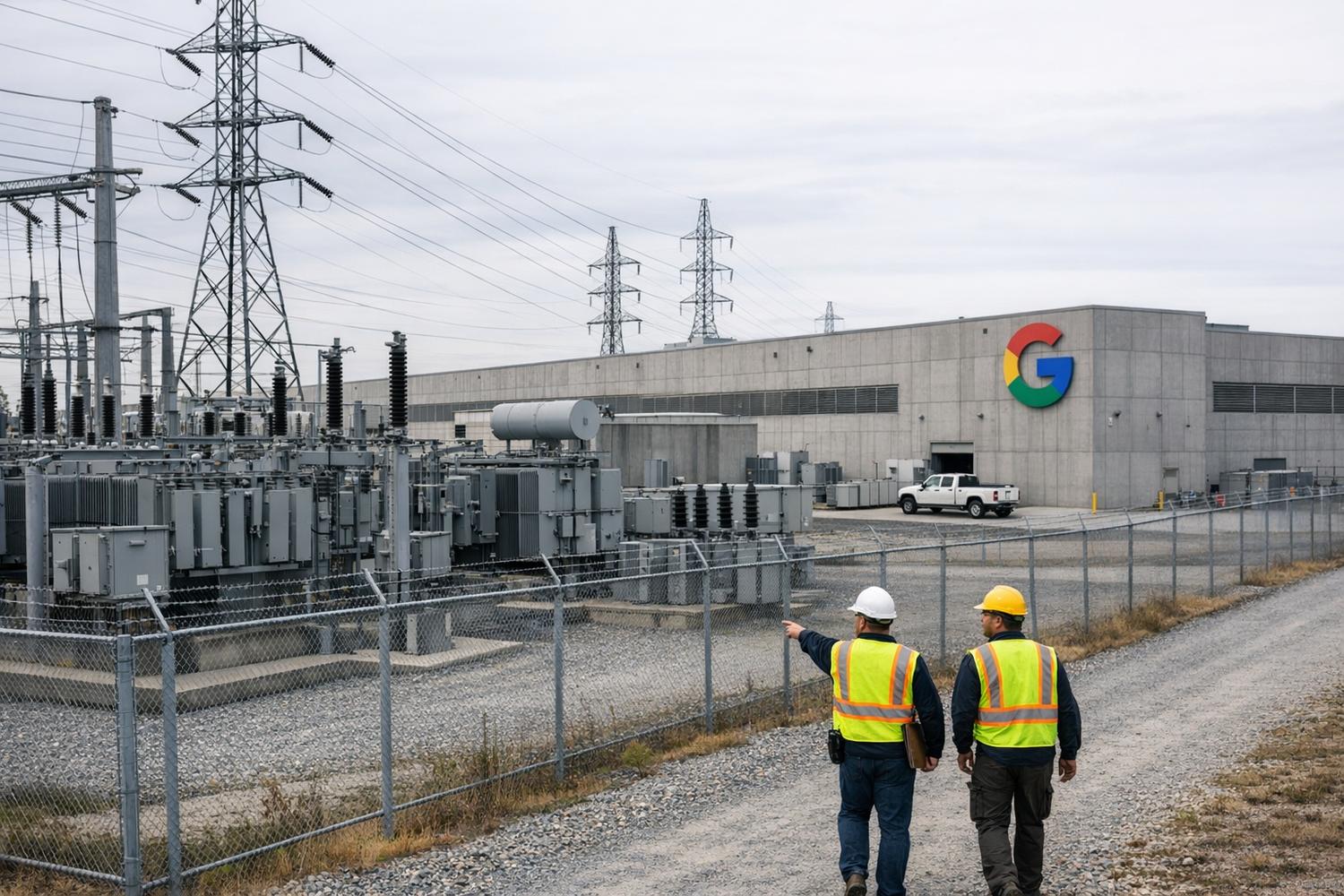
Intersect Power structures data centers as energy campuses, placing server halls beside power stations so that electricity, cooling, and land are planned as one integrated system. Projects blend combined-cycle units and flexible gas peaker plants with on-site renewables, backed by utility-scale battery storage and co-located generation assets that stabilize supply for power-hungry AI workloads.
The 4.75 billion dollar deal builds on Alphabet’s December investment of 800 million dollars in Intersect with TPG Rise Climate, tied to multi‑gigawatt data center projects. Alongside long-term renewable PPAs, Google has arranged about 3.5 gigawatts of capacity with NextEra, nuclear supply from Elementl Power, and a 1.5 TWh solar contract from TotalEnergies recently signed in November.
Will concentrated AI clusters overwhelm today’s power networks?
AI‑optimized campuses can draw several hundred megawatts apiece, turning areas of Virginia, Texas, and Ohio into emerging magnets for hyperscale computing and utility planning. Where many sites cluster, existing grid lines strain, new projects face permitting delays, and transmission bottlenecks turn these load concentration hotspots into expensive operational headaches for utilities and regulators.
Last year, AI workloads already accounted for about 1.5 percent of global electricity use, a share that is rising as generative models proliferate. Much of this demand flows through a limited number of grid nodes facing substation capacity constraints, so a single failure, heatwave, or fuel disruption can ripple through economies and digital services.
Investor and climate implications as energy becomes the bottleneck
Business plans for AI frequently assume abundant, cheap, low‑carbon electricity, an assumption that may break down where generation, land, or cooling cannot keep up. In those regions, over‑sized data centers and idle accelerators create a stranded assets risk, while reliance on gas plants forces uncomfortable emissions intensity trade-offs for operators.
Sundar Pichai has already warned that Google will miss some interim sustainability milestones as AI electricity use grows, illustrating how corporate climate targets collide with relentless appetite for compute. For investors, earnings trajectories depend increasingly on managing cost of electricity volatility through long-term contracts, on-site generation, diversified locations, and careful participation in wholesale power markets.